Strategic Approaches for Overseas Biotech and Pharmaceutical Companies Entering Japan
1. Executive Summary
Key Opinion Leaders (KOLs) play a critical role in pharmaceutical and biotech strategy, particularly in Japan where clinical practice patterns, academic influence, and guideline development are tightly interconnected.
However, many overseas companies misunderstand how influence actually functions within the Japanese medical ecosystem. As a result, KOL strategies frequently fail to generate meaningful impact on clinical development, regulatory communication, pricing discussions, or long-term market adoption.
Successful KOL engagement in Japan requires more than identifying highly visible professors. It requires understanding regional referral structures, informal academic networks, physician behavior, and long-term relationship dynamics.
This whitepaper outlines:
- The structure of KOL influence in Japan
- Common strategic mistakes
- KOL segmentation methodology
- Development-stage based engagement approaches
- Relationship-building best practices
- Strategic recommendations for overseas companies
2. The Strategic Role of KOLs
KOLs influence multiple dimensions of pharmaceutical success:
- Clinical trial design and feasibility
- PMDA communication and scientific credibility
- Guideline development
- Physician treatment behavior
- Real-world evidence generation
- Pricing and reimbursement discussions
- Post-launch adoption
In Japan, this influence is particularly strong because of:
- Centralized academic networks
- Strong linkage between academia and clinical practice
- High importance of peer consensus
- Long-standing referral relationships
Consequently, KOL strategy should not operate independently from clinical development or evidence planning. It should be integrated into the overall Japan market strategy from an early stage.
3. Understanding the Japanese Influence Structure
1. Academic Hierarchy
Japanese academic medicine often operates within strong hierarchical structures. Senior professors and department leaders may influence:
- Investigator participation
- Referral behavior
- Guideline discussions
- Publication opportunities
- Society activities
Understanding these dynamics is essential for effective engagement.
2. Informal Influence Networks
Formal academic titles do not always reflect true influence.
In Japan, influence may also depend on:
- Academic lineage
- Society relationships
- Historical collaborations
- Referral networks
- Regional leadership
Companies that rely only on publicly visible experts may overlook highly influential stakeholders.
3. Regional Ecosystems
Many overseas companies focus primarily on major Tokyo institutions. However, patient concentration and physician influence are often distributed across regional academic and referral ecosystems.
Regional leaders may strongly affect:
- Patient recruitment
- Treatment adoption
- Referral behavior
- Real-world evidence generation
Understanding regional ecosystems is therefore critical.
4. Hidden Influencers
In many therapeutic areas, mid-level practical experts may influence clinical behavior more directly than nationally recognized professors.
These stakeholders may include:
- Referral center physicians
- Guideline contributors
- Community-based specialists
- Emerging investigators
- Regional clinical leaders
Identifying these hidden influencers is often one of the most important elements of successful KOL mapping.
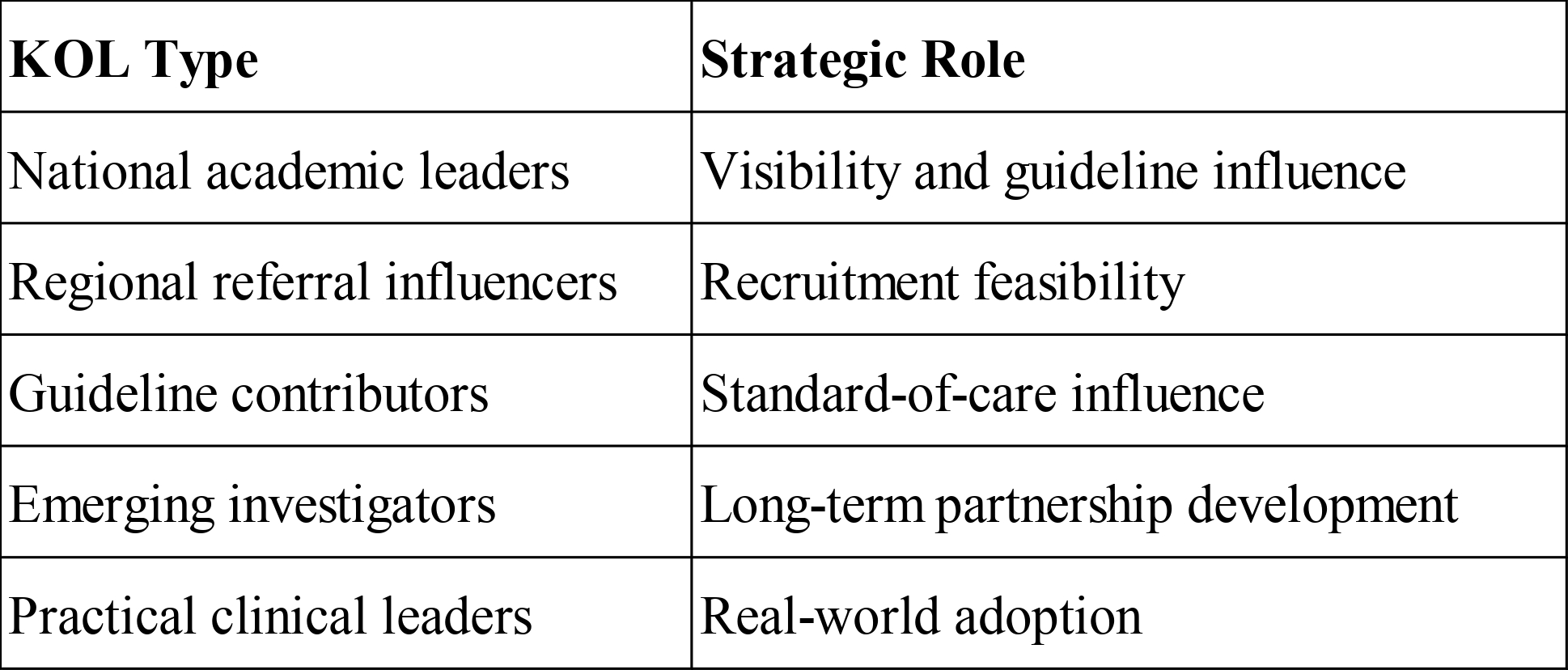
4. KOL Segmentation Framework
Effective KOL strategy requires multi-layer segmentation as follows:
5. Development-Stage Based KOL Strategy
1. Preclinical / Early Planning
Objectives:
- Disease landscape understanding
- Unmet need assessment
- Local treatment pattern evaluation
2. IND Preparation / Early Clinical Development
Objectives:
- PMDA perspective
- Clinical relevance validation
- Feasibility assessment
3. Phase II / III Development
Objectives:
- Recruitment optimization
- Site selection support
- Operational feasibility
- Scientific advocacy
4. Pre-Launch Phase
Objectives:
- Guideline positioning
- Publication planning
- Scientific communication
- Physician education
5. Post-Launch Phase
Objectives:
- RWE collaboration
- Long-term evidence generation
- Scientific dissemination
6. Common Failure Patterns
1. Over-Reliance on Global Assumptions
Global headquarters often assume that development strategies successful in the US or Europe can simply be localized for Japan. However, differences in treatment patterns, referral systems, and evidence expectations frequently alter feasibility.
2. Selecting the Wrong Influencers
Many companies focus exclusively on highly visible professors while overlooking regional or practical influencers who shape daily clinical practice. Visibility does not always equal operational influence.
3. Late Engagement
KOL engagement initiated after protocol finalization often limits strategic flexibility.
By that stage:
- Recruitment risks may already be embedded
- Evidence gaps may be difficult to correct
- PMDA concerns may emerge later
4. Overly Promotional Communication
Japanese KOLs generally respond poorly to highly commercial or aggressive communication styles. Scientific credibility and long-term trust are significantly more important than short-term promotional visibility.
7. Relationship Building Methodology
1. Scientific Partnership Model
KOL relationships should be positioned as collaborative scientific partnerships focused on:
- Unmet medical needs
- Evidence generation
- Clinical improvement
- Scientific advancement
2. Advisory Board Strategy
Effective advisory boards require:
- Clear scientific objectives
- Appropriate participant selection
- Respectful moderation
- Long-term continuity
Advisory boards should not function as purely promotional activities.
3. Congress Engagement
Scientific congresses provide important opportunities for:
- Relationship building
- Informal discussion
- Scientific exchange
- Visibility development
In Japan, informal interactions often become highly valuable over time.
4. Publication Collaboration
Collaborative publications and investigator-initiated studies can strengthen long-term scientific relationships while supporting evidence strategy.
5. Long-Term Trust Building
Trust in Japan is usually built gradually through:
- Consistency
- Reliability
- Scientific credibility
- Respectful communication
- Long-term engagement
Transactional approaches rarely generate durable relationships.
8. Integration with Evidence and Market Access Strategy
KOL strategy should support:
- Clinical development
- RWE generation
- HEOR planning
- PMDA communication
- Pricing strategy
- Market access preparation
- Publication planning
When these functions operate independently, strategic inconsistency often weakens execution.
Integrated planning creates stronger long-term positioning.
9. Strategic Recommendations for Overseas Companies
Successful companies entering Japan typically:
- Invest in local intelligence early
- Engage KOLs before major decisions are finalized
- Build multi-layer relationships
- Adapt communication styles to Japanese culture
- Integrate KOL strategy with evidence planning
- Focus on long-term scientific credibility
Approaches successful in Western markets often require substantial localization for Japan.
10. Conclusion
KOL strategy is not simply a medical affairs activity. In Japan, it is a core component of successful clinical development and long-term commercialization.
Companies that understand the structure of Japanese medical influence — including regional ecosystems, academic networks, and long-term relationship dynamics — are better positioned to achieve:
- Stronger clinical execution
- More effective PMDA communication
- Better evidence generation
- Improved physician adoption
- Stronger long-term market positioning
For overseas biotech and pharmaceutical companies, early and strategically aligned KOL engagement can become one of the most important determinants of success in Japan.
11. Contact
For further discussion on Japan KOL engagement strategy, please schedule a consultation with MSC.